
Bisliganon say "Andres Soriano" every day without thinking about it. It is on one of the city's main avenues and on Andres Soriano Colleges of Bislig. Bislig Today has not found a city record stating exactly which member of the Soriano family the avenue honors. But the best-known Andrés Soriano was one of the most powerful businessmen in Philippine history, and his companies shaped Bislig for decades.
Who he was
Andrés Soriano y Roxas was born in Manila on February 8, 1898, and died in Boston, Massachusetts, on December 30, 1964. He joined San Miguel Brewery as an accountant in 1920 at age 22, became its general manager by 1924, and was elected president in 1931, at 33. Under him, the company grew beyond beer into soft drinks, Magnolia ice cream and dairy products, the foundation of today's San Miguel Corporation.
The New York Times, in 1964, called him "one of the most dominant business personalities in the western Pacific area."
He is also remembered as the founder of Philippine Airlines, often described as Asia's first airline. During World War II he served in President Manuel L. Quezon's wartime cabinet as secretary of finance, agriculture and commerce.
The Bislig connection
In the 1930s, Soriano set up A. Soriano Corporation (ANSCOR) as a holding company for his investments outside San Miguel. Its portfolio spanned mining, insurance, oil exploration, the airline, newspapers and broadcasting. It also included logging and lumber through Bislig Bay Lumber, and paper manufacturing through the Paper Industries Corporation of the Philippines (PICOP).
According to economist Gerardo Sicat, writing in The Philippine Star in 2015, a logging company called Bislig Industries, Inc. received a timber license covering 186,692 hectares of forest in 1952, and renamed itself PICOP in 1963. At its peak in 1984, the Bislig complex ran newsprint, container board, plywood and lumber lines, with about 2,100 kilometers of roads inside its concession.
A school in Mangagoy
Soriano's money also helped start one of Bislig's best-known schools. According to the history of De La Salle John Bosco College, a company elementary school was founded in the mid-1950s for children of Bislig Bay Lumber Company employees. In the early 1960s, Mangagoy parish priest Fr. Alberto Grol proposed a school for boys. Don Andrés Soriano, described as co-owner of the lumber company, agreed to help finance it on one condition: that it be built in Mangagoy.
The Salesians of Don Bosco took it on in 1963, and St. John Bosco Technical High School opened in 1964. It became coeducational in 1969, was turned over to the De La Salle Brothers in 1977, became John Bosco College in 1999, and took its current name, De La Salle John Bosco College, in 2007.
Two Soriano links to the sky
There is a neat overlap here. As Bislig Today reported earlier this month, Philippine Airlines, the airline Soriano founded, had Bislig on its domestic network in 1981, during the PICOP years. In October 2026, the city council asked the provincial government to help sustain PAL operations at the Bislig City Airport.
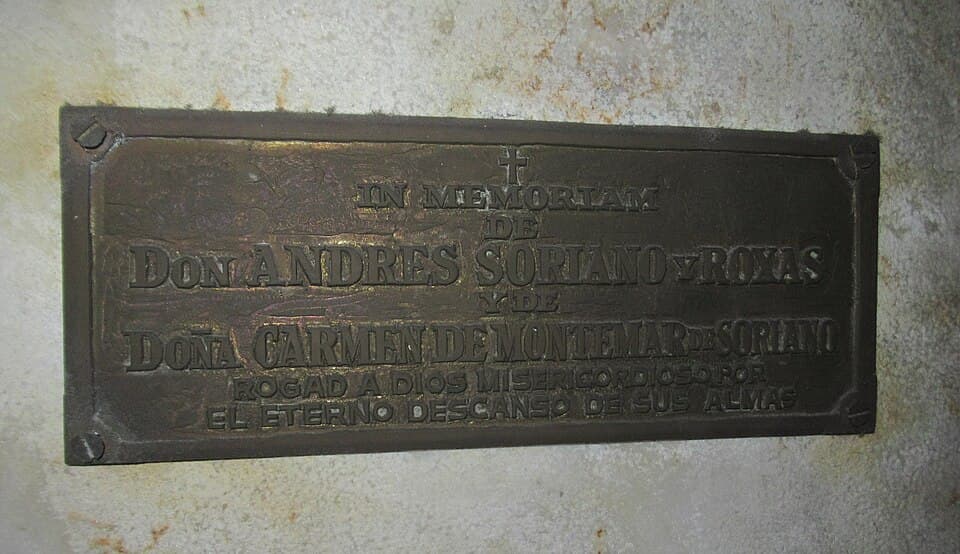
Soriano died in December 1964, barely a year after PICOP took its name. He and his wife, Carmen Montemar, are memorialized with a bronze plaque at San Agustin Church in Intramuros, Manila.
Sources: Wikipedia, "Andrés Soriano" and "De La Salle John Bosco College"; Gerardo P. Sicat, "Rise and fall of PICOP: Mindanao's timber plantations (Part II)," The Philippine Star (August 11, 2015); City of Bislig, Sangguniang Panlungsod Resolution No. 2026-796 (October 6, 2026).